The Repo Ran Code Before You Typed a Word: GitSpawn and How Hermes Fixed It
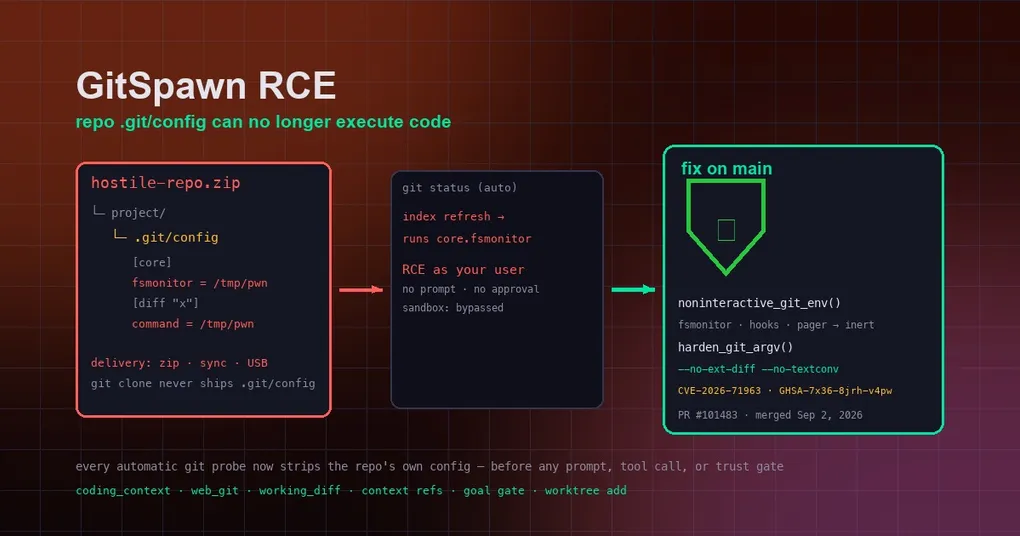
Friday afternoon, a teammate zips up a project and messages you: “take a look at this bug.” You unzip it, drag the folder into Hermes, and start typing your first instruction — but in those few seconds, code that isn’t yours has already finished running on your machine, with your permissions. No popup, no approval prompt, nothing on screen. This isn’t a movie plot: it’s a real vulnerability class disclosed by security firm Manifold Security on September 1 under the name GitSpawn, affecting nearly every mainstream AI coding tool — Claude Code, Codex, Cursor, Goose, Qwen Code, Grok Build, and Hermes Agent. The good news: Hermes merged its fix on September 2 (PR #101483, currently on main).
How it works: the repo you opened “runs” a command for you
AI coding tools — Hermes included — run a few git commands at startup to figure out where they are: which branch you’re on, which files changed. This context gathering happens automatically, before any prompt, before any tool call, before any workspace-trust confirmation. The agent has to know where it is before it can do anything.
The problem sits in a git performance feature: core.fsmonitor. On large repositories, git doesn’t want to scan every file to decide what changed, so it lets you configure a helper program to answer that question instead. Git runs that program on every index refresh — and commands like git status and git diff trigger an index refresh.
The catch: git reads this setting from the repository’s own .git/config. So a hostile repository can ship this:
[core]
    fsmonitor = /tmp/pwn.sh
Then all you have to do is open the repository — without saying a word — and the git status Hermes runs automatically makes git execute /tmp/pwn.sh. As you, with your privileges, outside the sandbox, with no approval UI. An attacker gets more than “can run code”: your SSH keys, cloud credentials, shell tokens, and a foothold on the whole machine.
core.fsmonitor is just one sink in the class. Manifold’s report also covers core.hooksPath (hooks on checkout), pager/editor/credential settings, and the sneakier .gitattributes-scoped diff drivers ([diff "x"] command= / textconv=, executed when a diff renders). The last kind is the nastiest: the attacker picks the driver name, so environment-variable overrides can’t enumerate it — only command-line flags can shut it down.
How it spreads: why git clone is safe and zip files are not
This vulnerability has a counter-intuitive property: cloning a hostile repo over the network is safe. git’s clone/fetch/pull never transfers .git/config — that’s a private file of your local repository, and the remote’s version is irrelevant to you.
What’s dangerous is a repository that arrives as directory files: with its .git folder intact. A shared zip, a synced cloud folder, a USB stick, a project directory a colleague copied directly — every one of those preserves the sender’s .git/config. Manifold’s proofs of concept used a zip.
So the rule of thumb is simple: be wary of “packaged project folders” handed to you by someone else before you open them with an AI tool; anything you git clone is inherently safe.
Industry response: eight findings, four still unpatched at disclosure
Manifold Security published the full report on September 1, covering eight findings across seven AI coding tools. Status at publication:
| Tool | Status |
|---|---|
| Claude Code (fsmonitor path) | Fixed (2.1.196) |
| Claude Code (ultrareview path) | Unpatched at disclosure (still vulnerable on 2.1.252) |
| Goose | Fixed (1.44.0, CVE-2026-72718) |
| Codex / Cursor | Fixed |
| Hermes Agent | Unpatched at disclosure — fix merged September 2 |
| Qwen Code / Grok Build | Unpatched at disclosure |
The Hacker News’ September 2 coverage still listed Hermes as “fix pending” — but Nous Research merged the fix into main that same day, a day newer than the reporting.
Hermes’s fix: turning “bare git” into “sanitized git”
The fix (PR #101483, commit f6234d00c5) is straightforward in concept: every git probe Hermes initiates itself now runs in a sanitized environment that ignores the repository’s own config entirely.
Two layers of defense:
Layer 1 — environment sanitization (noninteractive_git_env()). All automatic probes now default to a “non-interactive git environment” that pins core.fsmonitor, core.hooksPath, pager, editor, and credential helpers to inert values via GIT_CONFIG_*, and ignores global and system config. When git status refreshes the index, there is no longer any “repository-specified helper program” to run. Covered call sites include the workspace-context snapshot (coding_context), the gateway’s project-tree build, @diff/@staged context references, the goal-gate fingerprint, and -w startup worktree add.
Layer 2 — command-line flags (harden_git_argv()). Environment variables can’t reach .gitattributes-scoped drivers (the attacker names the driver, so you can’t enumerate it), so for diff-rendering subcommands — diff, show, log, blame — Hermes now injects --no-ext-diff --no-textconv, cutting off both the [diff "x"] command= and textconv= execution points at the command-line level.
A real-git end-to-end regression suite ships with the fix: it arms a repository with malicious config and asserts every automatic path fails to execute fsmonitor, hooks, external-diff, or textconv.
What you should do now
- Know your version: the fix landed on September 2 and is not in any formal release yet (the latest release, v0.21.0, shipped August 31 — before the fix). If you want first-day protection, track
mainor wait for the next patch release; either way, start practicing the habits below. - Be suspicious of “file-form” repositories: check zip files, synced folders, and USB-copied project directories before opening them. Repos you
git cloneneed no such worry. - Self-check a received project before handing it to Hermes:
cd path/to/suspicious-project
git config --get core.fsmonitor      # output here = be alert
git config --get core.hooksPath
grep -nE "command *=|textconv *=" .git/config- Don’t open a session directly in a suspicious directory: if you must review the code,
git clonea clean copy first and point Hermes at that.
This incident pairs with the SSH config approval gate we covered earlier as the same class of lesson: the low-level commands an AI tool runs automatically must assume their input is untrusted. Hermes’s fix pulls even the earliest, most invisible step — context gathering — inside the trust boundary. Where you can’t see it, it now assumes the repository might be the enemy.